Thursday, May 29, 2008

Observation #8

Site: Cottonwood Park
Date: May 29th
Time: 5:12 PM
Temp: 45 Degrees F
Weather: Cloudy, Windy, Rainy
Soil: Soaked
Observation #8
Standing out in the pouring rain, I noticed an influx in the bird population diversity. I saw several robins, starlings, and crows. They were displaying a fascinating show of interspecific competition. The starlings and the robins were fighting over worms that were coming out the saturated soil by the thousands. The crows tended to do their own thing because the other two species knew that the crow was much larger then them. The crow, with its larger body and black coloration, has the anti-predator adaptation of displaying intimidation. I hypothesize that the smaller species of birds had enough sense to know that taking on the crow in a battle royal for a worm would result in them coming out on the bottom. I think that they realize their place in the food chain. Speaking of the food chain, worms are decomposers and help to break down the soil and return nutrients to the earth. Between the worms and the birds, the symbiotic relationship mutualism is displayed. However, when the community of birds try to eat the worms, one could call this predator versus prey relationships. As I have seen the pond fill up in the tiny man made park near my house, I have noticed how biodiversity increases, and organisms interact differently within their environments. I have realized that nature has subtle ways of worming- no pun intended- its way into our everyday lives. We just have to take the time to notice.

Observation #7

Site: Cottonwood Park
Date: May 28th
Time: 2:58 PM
Temp: 48 Degrees F
Weather: Partly Cloudy, Windy, Rainy
Soil: Soaked
Observation #7
After several days of heavy rain, the park seems to be even greener if possible. This influx in rain has provoked hundreds if not thousands of dandelions to pop up through the green, creating a multi-colored smorgasbord of flora. These flowers add monumentally to the biodiversity of the ecosystem. The aspen trees have dropped all of their catkins and are starting to produce beautiful heart shaped leaves. I am sure that the plants and animals are very confused because of all the snow in between the rain and sunshine. With all the water in the park, there have been many different types of birds. I observed tons of peckish robins perched in the aspen trees. I also saw three robins preening themselves at the waters edge. They would get a little pond water on their bodies and shake it off. I think that this might be to make themselves cleaner, obviously, but also maybe to attract a mate. I do not know if they mate in the spring or fall, but I will look into it. Other then the exciting robins, the water level is the same, and there are still frogs 'illin like villains in and around the pond.

Wednesday, May 28, 2008

Works Cited

Works Cited

Brockmeyer, Jim. "Salix (Willow)." Golden Willow. 2008. Bluestem Nursery. 28 May 2008 http://www.bluestem.ca/salix-alba-vitellina.htm.

Canadian Biodiversity. 2005. 28 May 2008 http://canadianbiodiversity.mcgill.ca/data/sppphotos/%20mammals/moose.jpg.

Daniel Paul. 2000. 28 May 2008 http://www.danielnpaul.com/scan_image/Moose2.jpg.

"Golden Willow." www.ag.ndsu.edu. 29 Apr. 2008. NDSU. 28 May 2008 http://www.ag.ndsu.edu/trees/%20handbook/th-3-139.pdf.
Moose. 28 Mar. 2008. Wikipedia. 28 May 2008 http://en.wikipedia.org/wiki/Moose.

"Moose (Alces alces)."
Boreal Forest Library. 2002. The Wilderness Classroom Organization. 28 May 2008 http://www.wildernessclassroom.com/www/schoolhouse/boreal_library/animals/%20moose.htm.

"Salix alba (Golden Willow)." Salix alba. 17 Apr. 2008. Wikipedia. 28 May 2008 http://en.wikipedia.org/wiki/Salix_alba.

Thursday, May 22, 2008

The Golden Willow

The Golden Willow, or the Salix alba "Vitellina", is a large leafy tree that is rich yellow or orange in color. However, the undersides of the long ovular shaped leaves are white, resulting in the tree being called the White Willow as well as the Golden Willow. Native to Europe and Western Asia, this medium sized deciduous tree grows anywhere from thirteen feet to sixty feet tall. The Golden Willow reproduces through catkins, and are pollinated by insects. The catkins ppear during spring and look like tiny brown pine cones. These trees produce thousands of male and female catkins in a process similar to masting. They do this because, even though the willows are fast-growing, they don't live very long due to being susceptible to several different types of diseases. Bacteria thrive on the bark and leaves because the tree grows near water and emits heat. These relationships are an example of the symbiotic relationship parasitism because the tree is being killed while the bacteria are thriving.
These spindly trees thrive near water, and need large amounts of sun. However, although it needs large quantities of sunlight, the Golden Willow must have wet soil in order to survive. Also, the soil must be extremely rich in nutrients in order for them to grow as largely as they do. The willows in my observation site receive fertilizer from the town of Jackson, so I expect them to grow quickly. As all animals need water to survive, many animals prey upon the defenseless tree. We are lucky to have the Golden Willow around as its niche is to provide cover to many wildlife species, as well as producing food for game and song birds. Moose eat the branches ferociously in the winter time as they are easy to get to and full of nutrients. Many different species of birds eat the catkins that it produces in the spring time. Because it provides so much for other organisms in its ecosystem, it plays an important part in the food chain. Even though the willow produces all of this food to help other organisms survive, it destroys smaller grasses, and their niches, along side it. Because it guzzles up so much water, the plants with smaller root systems around can not receive enough water to survive.

Wednesday, May 21, 2008

Observation #6

Site: Cottonwood Park
Date: May 21th
Time: 5:15 PM
Temp: 37 Degrees F
Weather: Cold and raining
Soil: Soaked
Observation #6
It was pouring rain when I went to observe my site. The wind was blowing hard and the rain felt like ice on my skin. However, in all of this stormy weather, I was surprised to see the black birds around the edge of the park perched in the trees. I don't know why the birds were up in the trees being pelted by rain, but this proves that they are more accustomed to the elements then I thought they were. Not only were they in the tree tops, but several were sitting on abiotic factors such as the large rocks around the pond. With the rain, the flora is starting to become lush and even greener. Ive noticed that there are buds beginning to grow on the golden willows that will turn in to large leaves later on. I think that all the water will help the flora to thrive becasue in the summer when its hot out, the water evaporates too quickly for the roots to absorb. Wit the pond full and water falling from the sky, i think that the ecosystem will benifit greatly.

Tuesday, May 20, 2008

Observation #5

Site: Cottonwood Park
Date: May 19th
Time: 5:07 PM
Temp: 62 Degrees F
Weather: Sunny, Breezy
Soil: Moist
Observation #5
Breaking news in the Cottonwood Park today! The town filled up the pond! Right away I could see the increase of biodiversity in the area. When I arrived, I could hear several deep croaking noises. I hypothesized that the organisms responsible for the sound were frogs. After hunting around the waters murky edges for a while, Danika (my partner ecologist) and I sighted a tiny specked frog. The frogs back was dark green and spotted and it blended in extremely well in the water. This helps them to camouflage into the water, similar to how the birds have darker wings and lighter underbellies. Besides the frogs, there were many types of birds in the area such as Starlings, Robins, Chickadees, and the small song birds. These organisms were feeding on the biotic factors in the area such as the bugs present in the water. With the increase in temperature, I have noticed the increase in the activity of the birds in the park. Instead of just sitting in the tree tops like they used to, they are flying around and searching for food along the waters edge. This creates intensified interspecific competition between the biotic factors in the ecosystem for survival needs. They all need the five key components in order to survive, and with the increase in population, it makes it harder to receive these necessities. I am so excited that the pond filled up because this makes my area much more interesting and diverse!

Monday, May 19, 2008

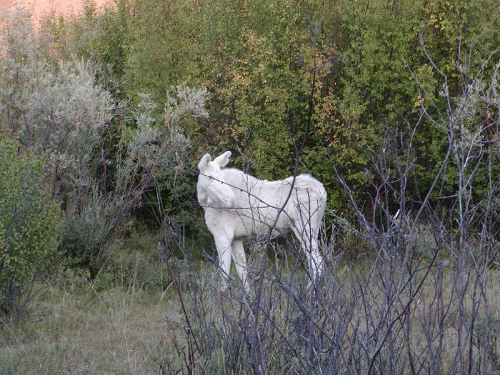
The Albino Moose

In about second grade, there was a song sweeping the county called “Moose” by the Banana Slug String Band. I know several of us know the song quite well and I remember it being the number one on my preschool pop list. I’m sure that the reason that all of us came to love this was because the moose is an amazing mammal.
Moose, Alces alces, are found throughout the United States and North America, including Wyoming. They prefer cool areas rich in water, because the water supplies a large quantity of their food supply. Even though you are most likely to find a moose in willow thickets, it’s also possible to find them in an environment with densely wooded forests filled with spruce, aspen, and small grasses. Moose get much of their nutrients out of the grasses by eating the entire plant, including the roots. This would be their niche because moose devours plants that may over populate the area, creating new niches for other plants and, in turn, other animals. They are very efficient at this job because in order to survive, they need to eat about sixty pounds of food a day! In addition to creating more space for organisms, when moose swim in ponds, their long legs stir up nutrients on the pond floor, like upwelling currents in the ocean, making the water nutrient rich for other biotic, or living, organisms. The Alces alces is a very important large animal in the North West.
Moose are the largest member of the deer family. Males can weigh up to 1,400 pounds, or about as much as eight grown men. Females can weigh about 900 pounds on average, but that number is susceptible to a large amount of change. Moose are extremely easy to identify due to their humped shoulders, large noses, and antlers. These magnificent antlers can weigh up to 75 pounds, or about as heavy as my sixth grade sister. Much of the energy the large mammal obtains goes into growing the antlers. Every year, these antlers are shed by the moose between December and January. In the early spring they begin to grow again. These antlers are useful for “sparring” with other males; however, they are hardly ever used in an actual fight, as they are often very peaceful creatures. As a defense mechanism, moose can run up to 35 mph, and lash out several feet with their spindly legs.